
The Deep Core
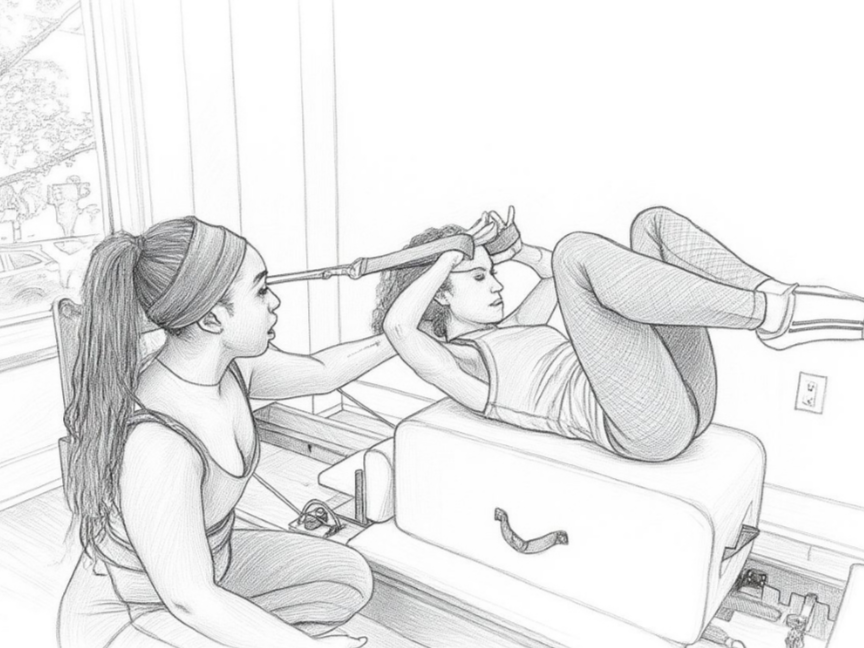
By KIN Kollective | Kinetic Intelligent Navigation | Brooklyn, NY |
Most people arrive at their first Pilates class with a specific, quietly held hope somewhere in the vicinity of their midsection. A stronger stomach. A flatter belly. Some visible return on investment for all those early mornings.
We completely understand.... We have mirrors too.
But here's what tends to happen somewhere around the third or fourth session: the goal doesn't disappear so much as it gets more interesting. Because Pilates, at its core (and we do mean that literally), is less about the stomach you can see and more about the spine underneath it. Once that distinction lands, the whole method opens up in a way that's genuinely hard to stop thinking about.
The Core Has Two Layers (And the Fitness Industry Has Been Training the Wrong One)
Your core is not a single structure. It operates as two distinct systems, an outer layer and an inner one, and understanding the difference is the foundation of everything we do at KIN.
The outer system is what most of the fitness world has been calling "core" for the past few decades: the rectus abdominis (the six-pack muscles running down the front of your torso), the external obliques, the larger muscles of the back. These are strong, they're visible, and they're excellent at producing movement. They are also, to put it plainly, not where the interesting work happens.
The inner system, known as the deep core or the local stabilizing system, is quieter by nature and significantly more consequential for how your body holds up over time. It lives closer to the bone, closer to the spine, and it includes four structures that deserve a proper introduction.
The transversus abdominis, or TVA, is the deepest layer of your abdominal wall, wrapping around the trunk like a built-in corset. It doesn't move your body; it stabilizes it, increasing intra-abdominal pressure and supporting the lumbar spine from the inside out.
The multifidus is a series of small, deep muscles running along either side of your vertebrae, responsible for precise segmental control of the spine. These are among the first muscles to quietly resign following a back injury, which is a leading reason why back pain tends to return even after it seems to resolve.
The pelvic floor is the hammock of muscles at the base of your pelvis. They support your organs, regulate pressure throughout the trunk, and contribute directly to spinal stability in ways that no amount of crunches will ever address.
The diaphragm, your primary breathing muscle, also functions as a core muscle, working in constant coordination with the pelvic floor to manage pressure throughout the torso. Breath and stability are not separate conversations. They are, it turns out, the same conversation.
Together, these four structures form what researchers call the "core canister." When they coordinate well, the spine is protected, movement becomes efficient, and the body has a genuine foundation to work from. When they don't, and the outer muscles compensate for a deep system that was never properly trained, the body finds creative workarounds, usually for years, until it runs out of them.
A Small Experiment Worth Trying Right Now
Here's something you can try wherever you happen to be reading this.
Lie on your back and lift your head and shoulders off the floor. Notice what recruits: probably some neck tension, some tugging through the hip flexors, a general sense that your body is working from all the wrong places. That's the outer system taking over because no one signaled the inner system to show up first.
Now try it differently. Before anything moves, take a breath. On the exhale, draw the lower abdomen gently inward, not a hard brace, not a sucking-in, but a quiet internal gathering, like someone asked your belly button to make a polite gesture toward your spine. Then lift.
The quality of that movement will be noticeably different. The effort redistributes. Something feels supported in a way it didn't before.
That subtle interior shift is your transversus abdominis beginning to participate, and this is the conversation Pilates has been having for well over a century. Joseph Pilates called it "the powerhouse." Modern spinal research calls it local stabilization. We just call it the thing that makes everything else work better.
What This Looks Like at KIN
Those who practice with us will recognize what we're describing. We spend real, unhurried time on what other studios might treat as a warm-up and rush past: the breath, the neutral spine, the subtle interior engagement that happens before the larger movement begins. For anyone accustomed to formats that hit the ground running (or burpee-ing), this can initially feel understated.
It isn't. It's the whole point!
When your instructor cues you to "find your deep belly" before a footwork series, they're asking your TVA and pelvic floor to engage before the Reformer's springs introduce any load. When the breath is directed into the back and sides of the ribcage, the diaphragm is being trained to function as part of the canister rather than around it. When someone notes that the ribs are drifting up in an overhead reach, they're catching the exact moment the outer system tries to quietly take over.
None of this is filler. It is architecture, and as any Cobble Hill brownstone could tell you, what holds everything up is rarely what's most visible from the street.
What Real Core Strength Actually Feels Like
A flat stomach and a stable spine are related, but they are not the same thing. One can present as visually lean while remaining structurally precarious. The conflation of the two has produced, over the years, a great deal of back pain and a fair amount of confusion.
Genuine core strength looks like moving from the center without holding your breath. It looks like your limbs traveling freely while the spine stays quiet and supported underneath. It looks like carrying a full bag home from the Cobble Hill farmers market without your lower back filing a formal complaint. It looks like recovering gracefully from a stumble on an uneven sidewalk, which Brooklyn provides ample opportunity to practice.
Above all, it feels like ease rather than effort. True deep core stability, once properly trained, becomes largely automatic, a neuromuscular intelligence that activates the right structures at the right moment without requiring your conscious involvement. That is what we are building toward at KIN. Movement that quietly supports your life rather than demanding your attention to function.
For Beginners and the Experienced Alike
If you're new to Pilates, welcome the subtlety of the early work. The nervous system builds these connections on its own timeline, and progress here often feels less like exhaustion and more like clarification. Students frequently leave their first few sessions not depleted but organized, standing a little taller, breathing a little more fully, with the particular satisfaction of having found something that was always there, waiting to be asked.
If you've been training for years and find that Pilates presents unexpected challenges, that's not a setback. It usually means the outer system has been compensating with great dedication for a very long time, and the deeper layer has simply been waiting for a proper invitation.
At KIN, we extend that invitation every single class. It's genuinely one of our favorite things to do.
Curious to experience this for yourself? Our Simple Start Plan, 3 classes for $89, is the ideal place to begin. You'll find us in Cobble Hill and Brooklyn Heights, and we'd love to meet you.