
Reformer Pilates in Brooklyn: The Intelligent Guide to Your First Class
You've done the research. You know Pilates isn't a trend. It's a method with over a century of biomechanical intelligence behind it. Now you're ready to experience the Reformer for yourself. Here's what the other blogs won't tell you.
If you're reading this, you're probably not the type who walks into a fitness experience blindly. You've likely already scanned a few studios, compared class formats, and maybe even looked up the difference between a classical and contemporary approach. Good! That tells us you're exactly the kind of mover who thrives at KIN.
But even the most well-informed newcomer can feel a flicker of uncertainty before their first Reformer session. Not because it's intimidating, because the Reformer is genuinely unlike any other piece of equipment you've encountered. It doesn't operate on the brute-force logic of a weight machine. It operates on you! Your alignment, your neuromuscular patterns, your ability to control resistance rather than simply push against it.
So let's walk through what your first class at KIN Kollective actually looks and feels like, and more importantly, why each part of the experience is designed the way it is.
The Reformer Isn't a Machine. It's a Feedback System.
Most first-timers expect the Reformer to feel like gym equipment. It doesn't. The sliding carriage, the spring-loaded resistance, the straps and foot bar, they aren't there to load your muscles the way a leg press does. They're there to reveal how your body organizes movement.
Here's what we mean: when you press out on the Reformer, the springs don't just resist you, they ask a question. Can you maintain pelvic stability while your legs extend? Can you articulate your spine one vertebra at a time against variable tension? The Reformer gives you immediate, honest feedback about where your body compensates, braces, or loses connection.
This is why Joseph Pilates originally called his apparatus the "Universal Reformer." Not because it reforms your body through repetition, but because it reforms your relationship to movement. At KIN, we take that distinction seriously. Our instructors don't just cue exercises, they help you interpret what the machine is telling you.
What the Springs Actually Do (Beyond "Resistance")
Here's something most studios gloss over: spring tension on a Reformer isn't linear the way a cable machine or dumbbell is. Springs create progressive resistance, meaning, the load increases as the spring lengthens. This is significant because it mirrors how your muscles naturally generate force and it means the same exercise can feel completely different depending on the spring configuration.
At KIN, our instructors will set your springs before each exercise and often explain why a particular setup was chosen. Lighter springs aren't necessarily easier. In many cases, a lighter spring demands far more core stabilization because the carriage moves with less control. Heavier springs can actually provide more support during certain movements, acting almost like a guide rail for your body.
When you hear your instructor say "we're going to one red and one blue," you're not just hearing a setting. You're hearing a deliberate decision about what your body needs to learn in that moment. This is part of what we call Kinetic Intelligent Navigation: understanding why the movement is programmed the way it is, not just following along.
Before You Arrive: A Few Things Worth Knowing
What to wear:
What makes Pilates uniquely effective isn't just the physical challenge, it's the continuous feedback loop it creates between your mind and body. Unlike exercises where you can mentally check out and let your body go on autopilot, Pilates requires sustained, focused attention. You have to be present, or the movement simply doesn't work.
This focused awareness activates your prefrontal cortex, the part of your brain responsible for executive function, emotional regulation, and what neuroscientists call "cognitive control." Basically, it's the grown-up part of your brain that helps you not react when someone steals your taxi or sends that passive-aggressive Slack message.
When to arrive:
Plan to be at the studio about 10 minutes before your class begins. This gives you time to settle in, meet your instructor, and get oriented to the equipment without feeling rushed. Our Cobble Hill and Brooklyn Heights studios were designed to feel like a pause from the pace of the city the moment you walk in…let yourself actually take that pause.
What to eat (and when): A light snack about 60–90 minutes before class is ideal. Pilates involves a significant amount of spinal flexion, rotation, and inversion, and a full stomach will make those movements uncomfortable. Think half an avocado on toast, a handful of almonds, or a banana, not a grain bowl.
What to eat (and when):
A light snack about 60–90 minutes before class is ideal. Pilates involves a significant amount of spinal flexion, rotation, and inversion, and a full stomach will make those movements uncomfortable. Think half an avocado on toast, a handful of almonds, or a banana, not a grain bowl.
What Your First Class Will Actually Feel Like
Let's be honest about the first 10 minutes: there will be a learning curve. The Reformer carriage slides, the straps pull in directions you don't expect, and your body will momentarily forget how to do things it normally does without thinking. This is completely normal and it's actually the point.
Your instructor will walk you through the basic positions, footwork on the bar, hand placement for pulling straps, how to get in and out of the machine safely. In a KIN class, you'll notice that our instructors don't just tell you what to do; they explain why each position matters. When we say "draw your ribs toward your hips," we're not speaking in abstract fitness language, we're cueing your transversus abdominis to stabilize your lumbar spine before your limbs begin to move. Understanding the intent behind the cue changes everything about how your body responds to it.
By the midpoint of class, something clicks. The carriage starts to feel less foreign and more like an extension of your own movement. You'll begin to sense the difference between muscling through an exercise and actually controlling it. That distinction, effort versus control, is the foundation of every class we teach.
You'll likely feel muscles you didn't know were available to you. Not because the workout is punishing, but because the Reformer is precise enough to find the layers your body has been routing around. Most people walk out of their first session saying some version of the same thing: "That was harder than I expected, but not in the way I expected."
The Part Nobody Talks About: Your Nervous System
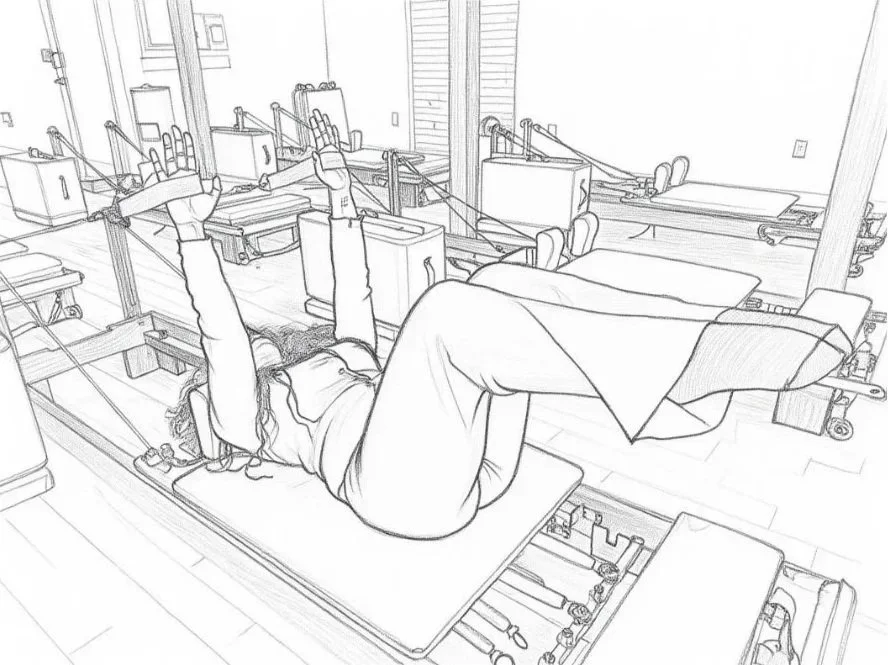
Here's where we go beyond what you'll read on most studio blogs. Reformer Pilates doesn't just work your muscles, it works your proprioceptive system. Proprioception is your body's ability to sense where it is in space without looking. Every time you stabilize on a moving carriage, control a strap with one arm while your legs are in tabletop, or articulate your spine against spring tension, you're training the neural pathways that govern coordination, balance, and injury prevention.
This is why Pilates has such strong clinical support for rehabilitation and aging well. It's not just about building strength, it's about building intelligent strength. The kind that translates to how you carry groceries up four flights of stairs in your Carroll Gardens walkup, how you move through a crowded subway platform, how you sit at your desk for eight hours without your lower back staging a protest.
At KIN, we think about this constantly. Our programming isn't designed to make you sore, it's designed to make you capable. There's a profound difference, and our clients feel it.
Small Groups, Real Attention
KIN classes are intentionally small. This isn't an aesthetic choice, it's a pedagogical one. Reformer Pilates is a precision practice, and precision requires observation. Our instructors need to see your movement patterns, catch compensations in real time, and offer modifications that actually make sense for your body, not a generic "option B" shouted across a room of 20 people.
You'll hear our instructors give cues that are clearly directed at you, even in a group setting. That's because they're watching. They notice when your shoulder starts to creep toward your ear during pulling straps. They see when your pelvis shifts during single-leg work. And they'll adjust — with their words, with a tactile cue (always with permission), or with a spring change, so that you're getting the most intelligent version of each exercise for your body, right now, today.
This is what our clients mean when they say they "feel seen" at KIN. It's not a marketing phrase. It's what happens when class size allows for actual teaching.
After Class: What to Expect From Your Body
You'll probably feel taller. That's not an illusion, spinal decompression and deep stabilizer activation genuinely restore length that gets compressed through daily life. You may feel a pleasant fatigue in muscles around your hips, inner thighs, and deep core that you don't usually access. Some clients describe it as feeling "wrung out" in the best possible way, like their body was reorganized.
Soreness, if it comes, tends to show up in unexpected places: the space between your shoulder blades, your deep hip rotators, the lateral muscles along your ribcage. This is your body telling you that it found the stabilizers it's been skipping over. It typically resolves within a day and diminishes significantly as your body adapts over your first few sessions.
We recommend coming back within the week while the neuromuscular learning is still fresh. Two to three sessions per week is the sweet spot where most clients start to feel a real shift. Not just in strength, but in how they understand their own movement.
Why KIN? Because the Details Matter.
There are a lot of Pilates studios in Brooklyn. Many of them are beautiful. Many of them have talented instructors. What makes KIN different isn't any single thing, it's the accumulation of small, intentional choices.
It's the fact that our instructors explain the biomechanics behind the cue. It's the spring selection that's chosen for your body, not just the exercise. It's the class size that allows for genuine human connection. It's a studio philosophy built on the belief that movement should make you smarter about your body, not just more tired.
KIN stands for Kinetic Intelligent Navigation. We chose that name because we believe the most powerful thing a studio can do is teach you to navigate your own body with intelligence and care. Your first Reformer class is just the beginning of that conversation.
We'd love to have you. Book your first class at ourCobble Hill orBrooklyn Heights studio, and come see what movement feels like when it's designed to make you think.