
How Pilates Fixes the Damage of a Desk Job
Why Your Chair Is Not Entirely to Blame
There is a particular kind of exhaustion that has nothing to do with how much you’ve slept. One that settles in somewhere between the shoulder blades around 3pm, travels up the back of the neck by 4, and by the time you're waiting for the F train, has made your body feel less like something you inhabit and more like something dragging behind you.
If this sounds familiar, you are not alone, and you are not falling apart! You’re simply a human body that has spent the better part of a day doing something human bodies were never quite designed to do: sit still, stare forward, and hold it all together through sheer determination.
The good news is that Pilates was practically built for this problem, not because Joseph Pilates had opinions about open-plan office spaces, but because the principles at the heart of this method address, with remarkable precision, exactly what prolonged sitting does to the body and, more importantly, how to undo it.
Here's what's actually happening, and what we can do about it together.
What Sitting Does to Your Body (The Version Your Doctor Didn't Have Time to Explain)
The human spine is designed to move through a full range of positions throughout the day, flexing and extending and rotating and returning, built entirely for variety and change. A desk, by contrast, asks it to hold a single position for hours at a time, and the body, being endlessly and sometimes frustratingly adaptive, obliges, then gets remarkably good at staying there.
Over time, a few things begin to compound on one another in ways that are quiet at first and then suddenly very loud.
The hip flexors shorten, which matters more than most people realize. These are the muscles connecting your femur to your lumbar spine, and when you remain seated for extended periods they gradually tighten, pulling the pelvis into an anterior tilt and increasing the curve in the lower back. This is why so many desk workers carry chronic low back tension without any specific injury to explain it, because the culprit isn't a single incident but rather Tuesday through Friday, for several years running.
The thoracic spine, which is the mid-back and one of the more naturally mobile regions of the spine, stiffens and rounds forward, losing its capacity for meaningful rotation and extension over time. The ribcage compresses, the breath becomes shallower, and neither of these things announces itself loudly enough to notice until one day you try to turn and look over your shoulder and realize the range of motion you used to have has quietly packed up and left.
The deep core disengages, which is a connection most people haven't made. When you sit in a rounded, compressed posture for hours, the deep stabilizing muscles we discussed in our last post, the TVA, the multifidus, the pelvic floor, tend to check out entirely, because the body doesn't particularly need them to maintain a seated position. So they stop showing up, and the larger, more superficial muscles pick up the slack, which explains why so many people feel not just tight but genuinely depleted in their back and neck by mid-afternoon, even on days when they haven't done anything physically strenuous.
The shoulders round forward, the head drifts ahead of the spine, and the neck extensors begin working overtime to keep the skull from continuing its journey toward the keyboard. For every inch the head moves forward of its natural position, the effective load on the cervical spine roughly doubles, which means that by the time most people look up from their screens, they are carrying the mechanical equivalent of a small child on the back of their neck, without any of the joy a small child typically provides.
None of this is a moral failing, or a reflection of how disciplined you are, or a problem you should have caught sooner. It is simply physics, applied gradually and without announcement.
Why Pilates Addresses This So Directly
The reason Pilates is particularly well-suited to the desk worker's body isn't simply that it stretches what's tight or strengthens what's weak, though it does both of those things thoughtfully and well. It's that it trains the body to find its natural alignment and then move from there, repeatedly and with increasing awareness, until the pattern becomes familiar enough to show up in real life, outside the studio, during the moments that actually count.
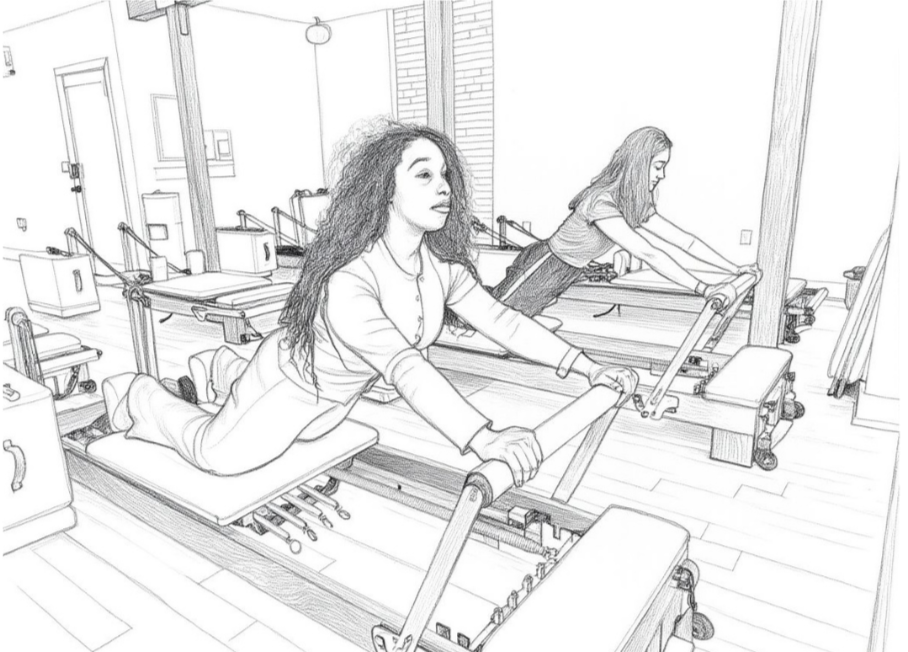
The Reformer, in particular, offers something no yoga mat or gym floor can replicate, which is adjustable spring resistance that meets the body exactly where it is. This matters enormously for people whose bodies have developed strong compensatory patterns over years of desk work. Rather than loading a dysfunctional movement and reinforcing it, the Reformer allows an instructor to find the position in which the body can finally work correctly, and build intelligently from there.
A few things that happen in a well-taught Reformer class that are almost comically well-suited to desk bodies:
Spinal articulation work asks the spine to move vertebra by vertebra, restoring mobility to segments that have been held still and compressed all day. The roll-down, the short spine, the elephant variation, these are not simply stretches but a genuine re-education for a spine that has forgotten how to sequence through its full range of motion.
Hip flexor lengthening is woven into almost every footwork and lunge variation on the Reformer, with positions precise enough to target the psoas and iliacus, the deepest of the hip flexors and the ones most directly connected to that chronic low back pull, without the compensations that tend to creep in when people attempt these stretches independently at home.
Thoracic extension and rotation are addressed throughout, particularly in the seated rowing variations and Tower work, asking the mid-back to do something it may not have done since early that morning, which is simply to open.
The deep core gets specifically and deliberately reactivated before any significant movement begins, which means that by the end of class, the muscles that quietly resigned sometime during your second morning meeting have been reminded that they exist, that they have a role, and that the body functions considerably better when they show up for it.
A Few Things Worth Shifting Outside the Studio
Pilates works best as part of an intelligent day rather than a corrective measure at the end of a damaging one, and there are a handful of small adjustments that make a meaningful difference without requiring any significant lifestyle overhaul.
Your screen should be at eye level, not below it, and if you are consistently looking down at a laptop for hours on end, your cervical spine is under constant strain that no amount of studio work will fully compensate for. A simple stand or external monitor is one of the more worthwhile investments you can make in your body, and it costs considerably less than chronic physiotherapy.
Moving every forty-five minutes to an hour matters more than most people think, and the movement doesn't need to be exercise so much as it needs to be a change of shape, standing at a window, walking to the kitchen, rolling the shoulders back and taking a full breath. The goal is simply variety, because variety is what the body was designed for.
Breath awareness during the workday is something we return to again and again at KIN, because most desk workers breathe shallowly into the upper chest for hours without noticing. A few deliberate lateral breaths, expanding into the sides and back of the ribcage the way we practice in class, can reset the nervous system in under a minute and restore some engagement to the deep core without requiring you to leave your chair or explain yourself to anyone nearby.
These are not dramatic interventions, and that is rather the point. Consistency with small, intelligent things tends to outperform occasional heroics, in movement as in most areas of life.
What to Expect in Your First Few Reformer Sessions
If you arrive at KIN carrying a typical desk worker's body, meaning a tight anterior chain, a compressed thoracic spine, and a deep core that has been on an extended sabbatical, your first few Reformer classes will likely reveal all of this, not painfully, but clearly. Movements that look simple will uncover restrictions you didn't know were there, and your instructor will modify and adjust accordingly, not because anything is wrong with you but because the work is precise enough to meet you exactly as you are.
Within a few weeks of consistent practice, most people begin to notice the same cluster of changes: less afternoon tension in the neck and upper back, a sense of standing taller without consciously trying to, and a growing awareness of when the body starts to collapse back into its old familiar patterns, which is itself a significant development. You can't change what you can't feel, and feeling it is always the first step.
The body that makes its way home along Montague Street after a long day does not have to feel like something to be endured. It is, after all, the same body that knows how to move well, with intelligence and ease and a certain quiet confidence, and it simply needs to be reminded.
Our Reformer classes at KIN are designed for all levels, including complete beginners, and our instructors are experienced in working with the specific patterns that desk work creates. Find us in Cobble Hill and Brooklyn Heights, or explore our class schedule and Simple Start Plan when you're ready to begin.