
Is Pilates safe during Pregnancy?
Pregnancy is one of the most profound physical transformations a body will ever undergo, and it happens, somewhat remarkably, while you're also expected to go about your life. To work, sleep, manage a commute, hold a life together, and somehow remain patient with people who feel entitled to comment on your body in ways they'd never dream of in any other context.
Movement during this season isn't just permitted. For most people, it's actively beneficial, and the research supporting this has become increasingly clear and increasingly encouraging. The question isn't really whether to move, it's how to move intelligently, in a way that supports what the body is doing rather than working against it.
Pilates, with its emphasis on deep core stability, postural awareness, breath mechanics, and controlled movement, is one of the most well-suited practices available to a pregnant body at any stage. It's also a practice that requires thoughtful modification as pregnancy progresses, and those modifications are worth understanding in real depth, not because exercise during pregnancy is inherently risky, but because an educated mover is always a safer and more empowered one.
Why Pilates During Pregnancy
The case for Pilates during pregnancy isn't simply that it's gentle enough to be safe, which is both true and somewhat underselling it. It's that the specific things Pilates trains are precisely the things a pregnant body needs most.
Pelvic floor strength and coordination. The pelvic floor supports a progressively increasing load throughout pregnancy, and research consistently associates stronger, better-coordinated pelvic floor muscles with reduced rates of incontinence, improved labour outcomes, and faster postpartum recovery. Pilates trains both the strength and the neuromuscular coordination of these muscles in ways that isolated Kegel exercises simply don't replicate, because it asks the pelvic floor to work in coordination with the breath and deep core, which is how it functions in real life.
Deep core stability without intra-abdominal pressure spikes. As the uterus grows, the deep abdominal muscles are placed under significant mechanical stress. Maintaining functional transversus abdominis activation helps support the lumbar spine and pelvis through postural changes that would otherwise place enormous strain on the surrounding structures. Critically, Pilates achieves this without the breath-holding, straining, or high intra-abdominal pressure that characterise conventional core training and should be avoided entirely during pregnancy.
Postural support through a shifting centre of gravity. As the belly grows, the centre of gravity moves forward, increasing lumbar lordosis and placing the hip flexors, lower back extensors, and thoracic spine under sustained compensatory load. The postural awareness and spinal lengthening threaded through every Pilates session help counteract these changes, reducing the low back and pelvic girdle pain that affects a significant proportion of pregnant people.
Breath capacity and regulation. The diaphragm becomes progressively compressed as the uterus expands into the abdominal cavity, and many pregnant people find their breath becoming shallower and more effortful as the months progress. Pilates breath training, particularly lateral costal breathing that expands into the back and sides of the ribcage, helps preserve respiratory capacity and maintain the breath-core connection that supports the whole system.
Circulation and oedema management. The controlled full-body movement of a Pilates session supports venous return and lymphatic drainage, both of which matter during pregnancy when circulatory demands increase significantly. Peripheral oedema, the swelling that accumulates in the hands, feet, and ankles as excess fluid collects in the body's tissues, is one of the most common and uncomfortable complaints of the second and third trimesters. It occurs because the expanding uterus places pressure on the pelvic veins, slowing the return of blood from the lower extremities, and because increased blood volume during pregnancy means more fluid available to leak into surrounding tissues. Gentle, rhythmic movement helps activate the muscle pump mechanism that moves fluid back toward the heart, and many clients find that even a single Pilates session brings noticeable relief.
Mental and emotional wellbeing. This one's less quantifiable but no less real. The quality of attention that Pilates requires, that unhurried, inward-facing focus on how the body feels from the inside, offers something genuinely valuable during a period of significant physical and psychological change. It's an hour in which the body gets to be listened to rather than managed, and that's worth more than it sounds.
How Pregnancy Changes the Body: What Instructors Are Watching
To understand the modifications that matter, it helps to understand the physiological shifts that make them necessary.
Relaxin. From early in the first trimester, the body begins producing relaxin, a hormone that increases ligamentous laxity throughout the body in preparation for the demands of labour. This doesn't just affect the pelvis, it affects every joint, meaning the body's natural stability and proprioceptive feedback are reduced throughout pregnancy. Movements that feel stable and controlled in a non-pregnant body may place undue strain on joints that are temporarily more vulnerable, and end-range stretching in particular should be approached with considerably more caution than usual.
Diastasis recti. The linea alba, the connective tissue running vertically down the centre of the abdomen, widens under the mechanical pressure of the growing uterus. This is a normal and expected process, but loading the rectus abdominis through traditional core exercises, particularly spinal flexion under load, can exacerbate the separation and compromise abdominal function both during and after pregnancy. Any exercise that creates visible coning or doming at the midline of the abdomen should be discontinued immediately.
Supine hypotensive syndrome. After approximately 16 to 20 weeks, lying flat on the back can cause the weight of the uterus to compress the inferior vena cava, reducing venous return to the heart and causing dizziness, nausea, and in some cases a significant drop in blood pressure. This is individual and variable, some people experience it earlier or more acutely than others, but as a general principle, sustained supine positioning should be avoided from the second trimester onward.
Cardiovascular changes. Blood volume increases by approximately 40 to 50 percent during pregnancy, cardiac output rises, and the resting heart rate is elevated. Perceived exertion shifts as a result, and exercise that felt moderate before pregnancy may feel significantly more demanding. The most useful guideline here isn't a heart rate target but a conversational pace — if you can speak in full sentences, you're in the right zone.
Modifications by Trimester
First Trimester
For most people, the first trimester allows for relatively few structural modifications. The uterus is still contained within the pelvis, positional restrictions aren't yet necessary, and most of the Pilates repertoire remains available.
The primary considerations are energy management, avoiding overheating, and beginning to shift the internal focus toward pelvic floor awareness and deep core connection rather than any loaded abdominal work. It's an excellent time to deepen the foundations — the breath, the neutral pelvis, the coordination of the pelvic floor and TVA — because these will carry the body through everything that follows.
Supine work remains appropriate, and the majority of the Reformer repertoire is accessible. If nausea is a factor, prone positions can be uncomfortable and are easily modified to four-point kneeling or side-lying alternatives without any loss of benefit.
Second Trimester
The second trimester typically brings a return of energy and a belly that's beginning to make itself known in movement. It's also the period in which the most significant modifications come into play.
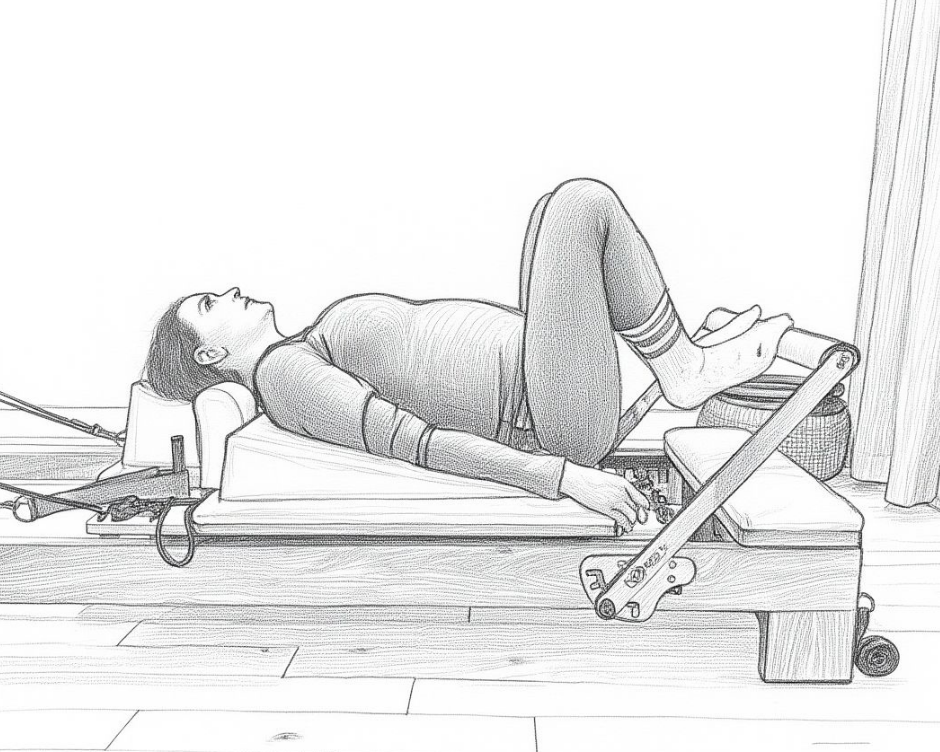
Supine positioning should be phased out or closely monitored from around 16 weeks, replaced with semi-reclined positioning at an incline of at least 30 to 45 degrees, or side-lying, seated, and standing variations. On the Reformer, this is easily accommodated by adjusting the foot bar and using the headrest or bolsters to support a semi-reclined position. The carriage provides excellent support for side-lying work, which becomes increasingly valuable as the pregnancy progresses.
Prone positioning is no longer appropriate as the belly grows and should be replaced with hands-and-knees, side-lying, or standing alternatives. Many prone Reformer exercises translate beautifully to kneeling on the carriage or footbar-modified standing work.
Traditional abdominal flexionexercises, including the hundred, roll-up variations, and any exercise that brings the head and shoulders into loaded spinal flexion, should be discontinued. The priority shifts entirely to maintaining deep core function through TVA and pelvic floor coordination, without loading the rectus abdominis. If there's any visible coning or doming at the midline, the exercise stops, regardless of how far along the pregnancy is.
Single leg work and balance challenges should be approached with additional care given relaxin's effects on joint stability and the shifting centre of gravity. Standing unilateral Reformer work may need a hand support, and the pace of transitions should slow down accordingly.
Deep hip flexor stretching should be gentle and controlled. Relaxin increases the risk of overstretching the ligamentous structures of the pelvis, and any aggressive lunge or split-stance position that creates anterior pelvic strain isn't worth it at this stage.
Third Trimester
The third trimester is a time for maintaining what's been built rather than building further, and the work becomes increasingly focused on breath, pelvic floor preparation for labour, and keeping the body comfortable and mobile as it approaches delivery.
Most of the repertoire continues to be available in modified form, with the emphasis on side-lying, semi-reclined, seated, and standing work. Load and intensity are appropriately reduced, not because the body can't handle movement but because the goal has shifted.
Pelvic floor work becomes specifically preparatory. Beyond strengthening, the focus shifts toward practicing coordinated release — the ability to fully let go of pelvic floor tension on cue — which is directly relevant to the second stage of labour. Many of our clients find this the most practically meaningful thing they learn in their prenatal practice, and it's something that no amount of Kegels alone will teach.
Extended exhale breath work supports the nervous system in preparation for labour, activates the parasympathetic response, and keeps the breath-core connection available during a period when the diaphragm is under significant compression from below.
Positions of comfort vary considerably between individuals in the third trimester, and a good instructor will follow the client's lead, offering options rather than prescriptions and adjusting freely as the session unfolds. The body knows what it needs, and the instructor's job at this stage is largely to listen.
A Note Before You Begin
Before starting or continuing any exercise programme during pregnancy, please ensure you have received clearance from your obstetrician, midwife, or primary care provider. Every pregnancy is different, and while Pilates is well-suited to most low-risk pregnancies, your care team is best placed to advise on what's appropriate for your specific circumstances. This post is intended to be educational and informative, and it isn't a substitute for personalised medical guidance.
At KIN, we require all prenatal clients to provide written clearance from their healthcare provider before their first session, and we ask that you keep us informed of any changes to your health status throughout your pregnancy.
What to Tell Your Instructor
Before any prenatal Pilates session, your instructor should know your current gestational week, whether you're carrying any obstetric complications including placenta previa, pre-eclampsia, incompetent cervix, or any history of preterm labour, and whether your care provider has issued any specific exercise restrictions. Most low-risk pregnancies are cleared for moderate exercise throughout, but individual circumstances always take precedence, and your instructor needs this information to work responsibly with you.
At KIN, prenatal clients are warmly welcomed and our instructors are experienced in adapting the Reformer repertoire intelligently through every stage of pregnancy. Our small group sizes and attentive teaching mean modifications aren't an afterthought — they're built into how we work.
After Baby
The postpartum period deserves its own post, and we'll return to it in depth. For now, the short version is this: the deep core and pelvic floor work built during a prenatal Pilates practice creates an exceptional foundation for what comes next. Returning to Pilates after delivery, with appropriate guidance on timing and progression, is one of the most evidence-supported things a new parent can do for their long-term structural health.
The body that carried a pregnancy isn't a body that needs to be punished back into shape. It's a body that did something extraordinary, and it deserves movement that meets it with the same intelligence and respect it's just demonstrated.
Our Private Sessions are the ideal format for prenatal clients, offering fully individualised programming that adapts with you through every stage of pregnancy. We practice in Cobble Hill and Brooklyn Heights, and we'd be honoured to be part of your journey. Please review our Pregnancy Policy for full details on how we support expectant clients.